Reading and summarizing/reviewing The Unseen Battle: Spiritual Warfare, the Three Rebellions, and Christ’s Victory Over Dark Powers by Joel Muddamalle
Chapter 2 – God’s Supernatural Family
God obviously has a human family, but what about a spiritual family? We moderns, with a triune God and some angels firmly in place as a picture of the Christian supernatural world, don’t have a complete picture of the basics. God has an inner circle of sorts, made of spiritual beings similar to him, that He considers close enough to be called a family, and this family plays a very large part in what happens in the supernatural domain.
Muddamalle cites the creation of man narrative in Genesis 1:26 as a clue about the existence of this inner circle: “Then God said, ‘Let us make mankind in our image, in our likeness, so that they may rule over the fish in the sea and the birds in the sky, over the livestock and all the wild animals, and over all the creatures that move along the ground.'” The Hebrew grammar doesn’t allow for God to be talking to Himself, nor does it allow for whomever he is addressing to be creating with him. It’s the figurative “let’s,” where God is including a group of beings as a collective witness, while He’s the only one performing the actual creative act. It’s similar to how we use “let’s” in: “Let’s order a pizza,” when only one person is doing the ordering. Let’s say the “let’s” isn’t indicative as a group activity like it’s shown in that wonderful scene from Police Squad.
We move to references in the Babel narrative, then to a number of Psalms, and to Job, all of which directly reference to these elohim in various ways, depicting them as God’s witnesses, advisors, or executive team. They are shown as very much “in the know” and participatory for what God does in both the cosmic and earthly realms.
The strange nephilim narrative of Genesis 6 provides more clues as to how these “sons of God” (bene elohim) can operate. Some scholars argue elohim refers to righteous descendents of Seth, Adam and Eve’s third son, and not divine beings. This isn’t likely as the Sethites aren’t referred to as elohim anywhere else, and the fact that evil giants descending from a purely human couple doesn’t follow, especially when there’s no other text, Biblical or otherwise, that would account for this.
Muddamalle examines the “divine kingship” explanation for the nature of the bene elohim of Psalm 82 and elsewhere: that they are actually human rulers or kings. This view is supported by references to the human “judges” in Exodus, but the linguistic connection is weak, and it doesn’t explain how a line of antediluvian human kings make it past the flood when there’s no supporting text for that, either. Muddamale cites Psalm 82:6, where God tells the other elohim that they are the “sons of the Most High,” but they will die like mortals, indicating that death wasn’t in their nature. God wouldn’t likely say that to already-mortal men.
Muddamalle also points to writings of early church fathers, like Justinian, Philo, Iraneus, who attest to these beings as divine, and mention that contemporary Jews also saw them as such.
A team or council of elohim that rule the cosmic and natural realms, sometimes in concert but also as rivals, is a concept well-attested to in Mesopotamian cultures. But “elohim” as a word is used to refer both to these divine beings and of this head God Himself. How could the capital-g God be inherently special when there’s more than one of Him? This is a rather big point of content Heiser had brought up and addressed numerous times. A clue to resolve the seeming polytheism of equal beings can be read in Psalm 82:1: “God has taken his place in the divine council; in the midst of the gods he holds judgment.” All throughout scripture, writers propose a small but significant twist to the standard Mesopotanian “divine council” lore, the idea of a head Elohim, a unique leader above all the other members. Clearly, the multidudinous elohim are more powerful and more intimately regarded than scripture’s angels, but the elohim are not at the level of the head Elohim. God is “species-unique” as an elohim: there’s no one like Him. He’s the only one at His level.
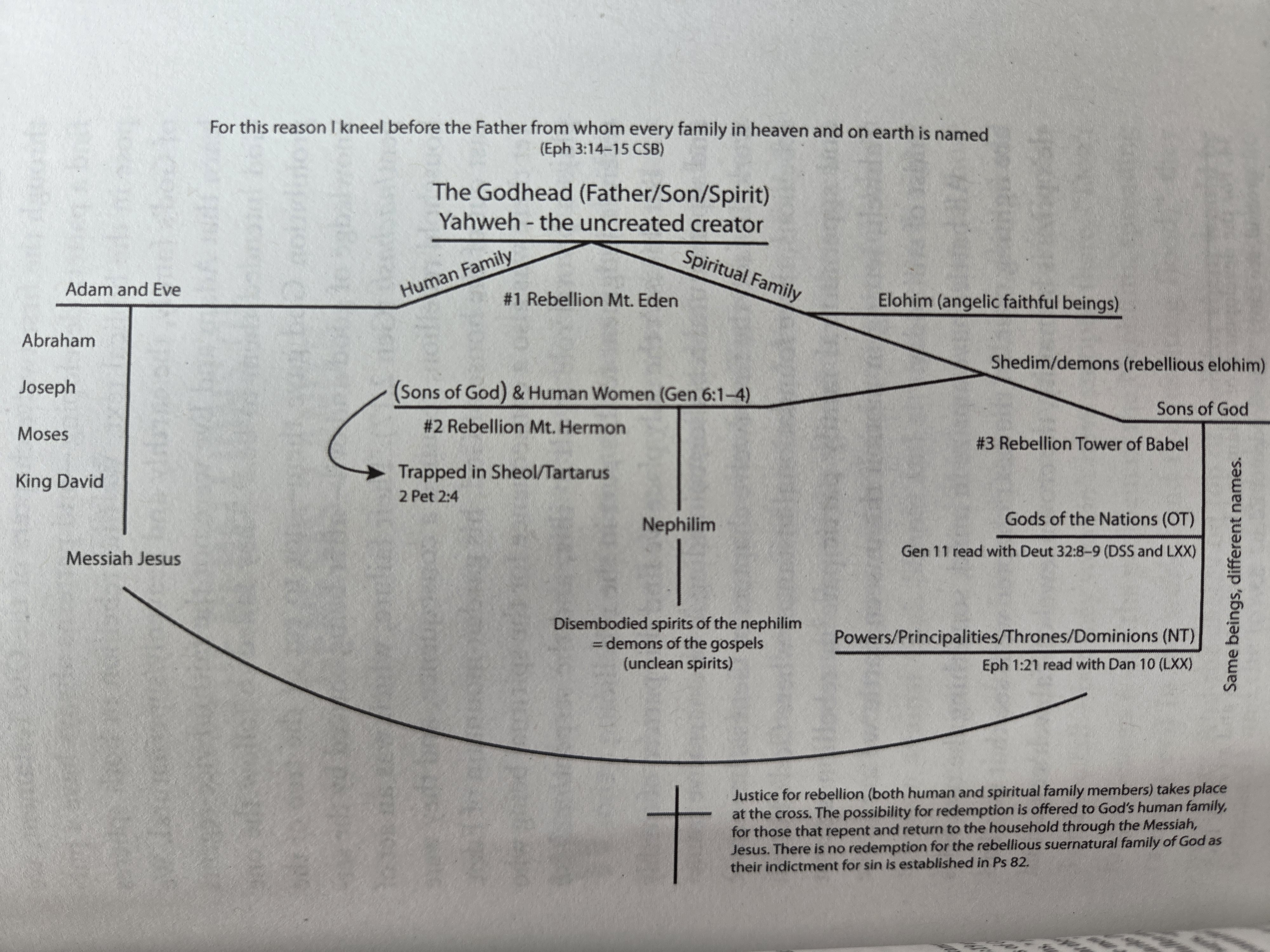
This relationship, and a basic chronology of relevant events and players, is helpfully demonstrated with this disagram that closes out the chapter, and offers a bit of a spoiler for the rest of the book:
2 Comments
“The Hebrew grammar doesn’t allow for God to be talking to Himself, nor does it allow for whomever he is addressing to be creating with him.”
Fascinating! Perhaps this isn’t as much of a Trinity verse as I had thought.
If we didn’t have second temple literature and weren’t aware of what they thought of scripture in that time period, a trinity explanation is probably the best accounting for this.