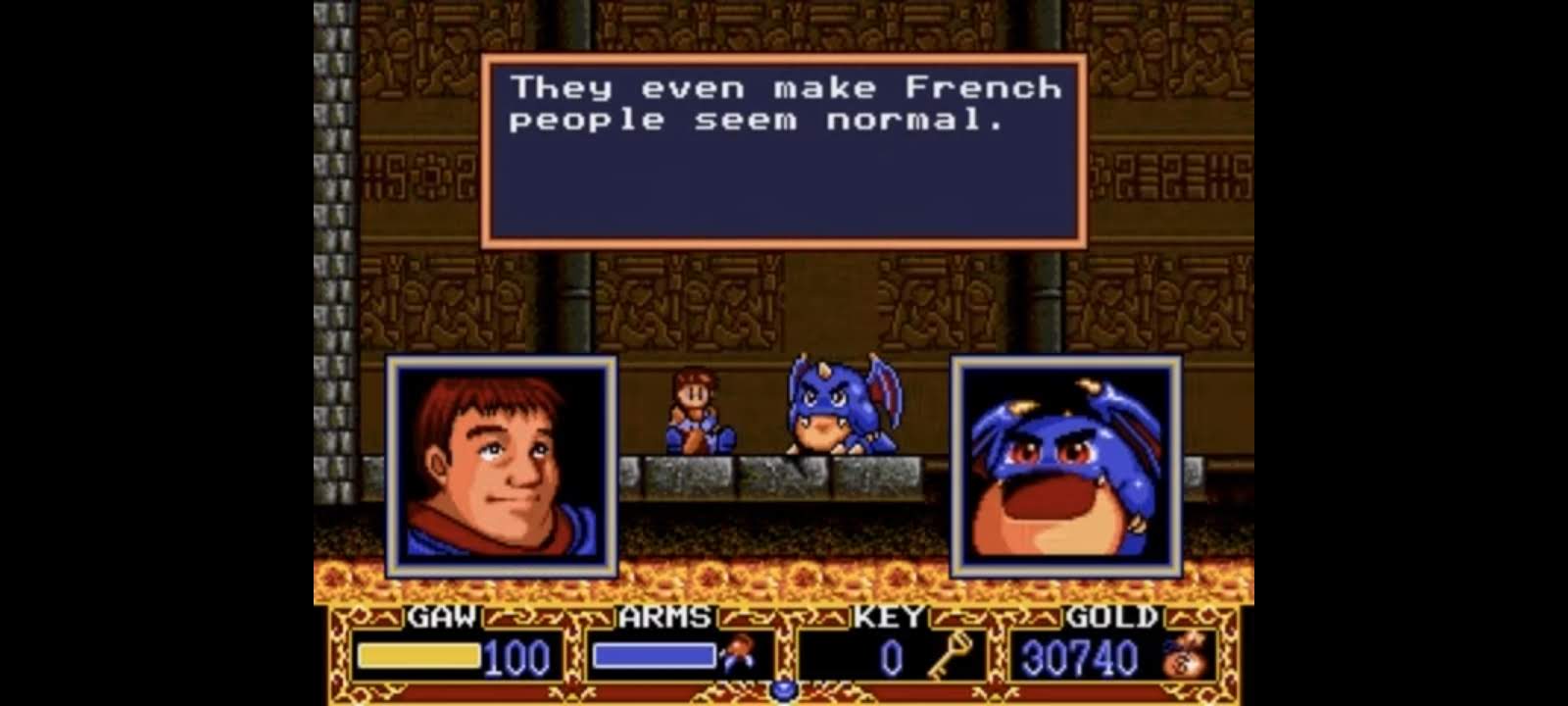
Popful Mail (video game)
Plucky bounty hunter Popful Mail finds herself in deep danger when an ancient evil named the Overlord resurrects.
Recommended to me by a friend who knows games and writes them. Weird name, weird game. It’s a narrative-heavy side-scroller and platformer. Especially back then, that was a combination that rarely happened, or rarely happened well. Castlevania II: Simon’s Quest and
Zelda II: The Adventure of Link were similar predecessors, but they had open world, non-linear gameplay, where Popful was very linear and structured and had dialogue that functioned beyond just moving the game’s plot forward. Popful goes nuts with humorous dialogue, characterization, and mostly-good voice acting.
Popful also had advanced (for the time) cinematic scenes, which I don’t know how they were done. Though they were essentially cartoon scenes, they look like standard sprite art, but there must’ve been a way it was drawn and then rendered somehow with early-90s/late-80s tech, to reduce pixel-plotting time. Although, I watched a playthrough of the Sega CD version, and I don’t think the cinematics were in all the versions. I’m too lazy to look up its development history.
Watch the playthrough here: Popful Mail (Sega CD) Playthrough – NintendoComplete. It’s only 5 hours long, but it’s even shorter when you skip the majority of the gameplay, some of which is grinding.
Snatcher (video game)
In Neo Kobe City, ew JUNKER police force member Gillian Seed hunts down and destroys Snatchers: humanoid robots that replace the humans they kill.
Another recommended playthrough. Blade Runner meets Invasion of the Body Snatchers, so heavy on the Blade Runner aspect that it could easily take place in that universe with a few name changes.
Like Popful Mail, there was plenty of voice acting that puts you right into the universe, which here I think is necessary because of the menu-based, point-and-click gameplay. Something about typical movement and exploration of video games that grounds you in another world that visual novel-type games need to make up for. The voice acting here is a bit stronger, I think, than Popful Mail, maybe because of the more serious tone.
There were some spots where there was straight-up exposition of Neo Kobe, when you access the Jordan computer system data files. It makes some sense because Gillian is new to the city and doesn’t know much about its culture, so giving the player a way to read up on things feels natural. As the game progresses you do get to experience all the things mentioned in the files, so it almost seems pointless to read about it and then actually go through it. Maybe it’s because the player in the walkthrough I watched had read the files early on in the game, when you can access them at any point during the game.
The background “music” when you’re using the computer, by the way, is absolutely horrendous. I hope it’s not diegetic because any character needing to use the Jordan system for an extended length of time would delete themselves.
The game does get goofy at times, usually to decent effect. There are appearance of other characters in Konami games, or characters outright mentioning the game’s developers. The writers nearly lifted word-for-word the noodle ordering scene from the beginning of Blade Runner at around the 3:34:00 mark in the playthrough link below. There’s a borderline “culturally insensitive” Chinese informant named Napoleon who dresses up as Santa Claus (lol). Gillian’s robot sidekick, not always the most helpful assistant, provides some comic relief without going over the top.
The story does have some logistic drawbacks, like the villains divulging their plans to the protagonist so the plot can move forward. It’s poor writing but that’s somewhat of a tradition in less-prestige types of crime dramas. JUNKER’s awful operational security is mind-blowing: the chief, Benson, (spoiler) was a Snatcher. Since anyone can be replaced by a Snatcher without anyone knowing, precautions to check for them within JUNKER HQ on a daily basis would be a thing. The Snatcher problem had direct connection to a worldwide disaster and a special forces-type of organization would not have had a blind spot like that. Oh well.
Playthrough is here: Snatcher (Sega CD) Playthrough
Battle Angel (1993)
A revived cyborg fights against organ thieves in Scrap Iron City, a literal dump stuck in the shadows below the affluent floating island of Zalem.
Clocking in at almost an hour, with two “episodes”—almost a movie, almost a series. This is obviously based on the manga and related to the Alita: Battle Angel that was released for western audiences, which, despite being highly-rated, never got a sequel. This was a lot more graphic than the newer version; American audiences would not stand for seeing children or domesticated animals getting hacked away on screen.
I might say this was a better version, but this was the early 1990s and American voice acting for anime just wasn’t at the level it has been in recent years. It was still treated like kid’s stuff, so there was a lot of over-emoting (the grunts and yelling and crying were everywhere) and a simplified script. The animation quality was dated but quite good for the time for a non-Disney production.
Watch it for free on YouTube: Battle Angel – 1993 Full Movie (Gunnm)
Project Hail Mary
A molecular biologist and a rock crab alien work together to figure out how to save their planet’s suns from being dimmed by a species of astral microbe.
Arrival meets The Martian, the latter sharing the writer of the same source material book, Andy Weir.
This has been all the rage recently, and I suppose for good reason. It’s a strong science-fiction adventure with a handsome, well-known lead playing a goofy star-bound everyman, mild cursing and no nudity, and lots of stylized visuals and humor. It’s a family affair, with a good bit of saccahrine sprinkles. Like Weir’s The Martian, it’s NASA propaganda with a strong dose of international cooperation injected, though in Mary’s case the lip service is more nuanced; The Martian’s approach featured NASA’s control center nerds and executives chomping up a good bit of screen time.
The grossly inhuman prescence of the alien Rocky—the eyeless, crab-shaped series of connected rocks—is somehow outweighed by his loveability. At first I thought that was due to puppeteer James Ortiz’ voice acting (his perfomance was originally intended as a scratch track). Despite Rocky’s intelligence, the diegetic translation of his echolocative chitters result in caveman Yoda dialogue, and his excitement about learning and appreciation (and criticisms) of humanity is childlike. He’s more or less materially human in a different form.
Not that I need 100% realism in everything, but the explosion scene was notably real-world. The explosion, occuring miles away from where Grace and Stratt are, is seen long before its sound and shockwave reaches them.
Backrooms
A divorced middle-aged man discovers a portal into a mysterious series of rooms that defy conventional logic.
The Blair Witch Project meets Event Horizon in a furniture store.
A film based on a 4chan meme and series of short videos, directed by the video creator’s 20 year old originator, Kane Parsons. Parsons graduated from film school and only had a few years of amateur directing. Enter A24 Studios and Parsons is able to not only direct it but direct it well? The pedigree of how this came about boggles the mind.
The set work and wardrobe personnel deserve a lot of credit. Backrooms is partially a period piece set in the early 1990s, and the easy route to establish modern settings from a past decade would have been to include popular contemporary songs. Instead, Backrooms relied on technology (camcorders, CRT televisions) and fashion (pleated khakis, furnture prints, shoulder pads) as cultural indicators. You didn’t hear or see anything to do with Nirvana or Pearl Jam.
Had Hollywood gotten ahold of this, it would’ve forced its formula onto the lore like it did with A Minecraft Movie. The two leads, Chiwetel Ejiofor and Renate Reinsve, are fine actors and were able to add the appropriate depth to the characters to the character-driven plots. Both plots A and B were based on the leads’ psychological problems, and owing to the nature of the backrooms, those problems are made manifest. The whole movie would fall apart if either Ejiofor or Reinsve failed to deliver.
3 Comments
The first two are totally new to me. I’ve seen bits and pieces of Battle Angel and I don’t like the artwork. The other two I’ve seen via recaps/summaries. I really liked Hail Mary, but the Backrooms struck me as just silly.
Backrooms is definitely a Gen Z thing.
https://arkhaven.substack.com/p/gen-z-horror-the-backrooms
Yes, I remember the original image of the yellow-walled backroom photo released some years back, read the discussions about the actual location and how the image was a perfect horror film setting. But because I understand the psychology of American horror stuff, I still say it’s silly.