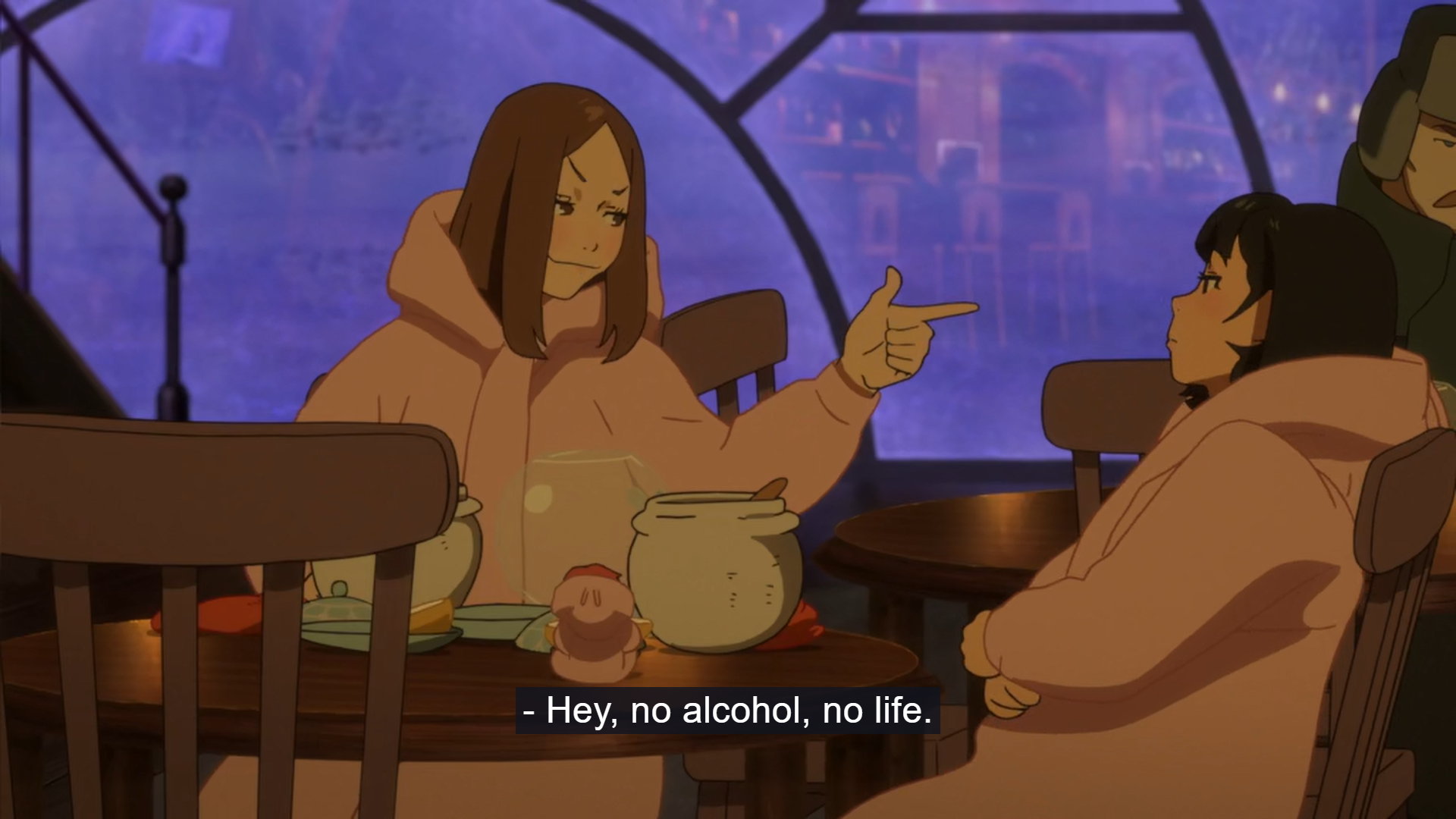
Birthday Wonderland
On Akane’s 12th birthday, a mysterious alchemist teleports her and her aunt Chii to a parallel world in crisis.
Watch it here for free, at least for now: The Wonderland. The Japanese title is literally, Birthday Wonderland, which a lot more fun than the English title version, so I went with that one. “Birthday Wonderland,” though, implies something that doesn’t quite bear out in the actual story.
Whenever you have an isekai movie with a young girl protagonist, it’s always going to be measured against Spirited Away, even if unfairly. It’ll never compare, since Spirited is the Back to the Future of the anime world with unprecedented crossover appeal.
Keiichi Hara (director) played it too safe here, but not in the sense of making Birthday Wonderland too bland or childish, but in holding back the setting of the Wonderland—I don’t think that was its name but let’s go with it—from breathing freely and telling its own story. Here’s where I bring up Spirited Away again, to illustrate. Miyazaki didn’t fall into the easy trap of explaining everything you were looking at. He let its story be told through Chihiro’s character growth and letting the audience take in supernatural world to which she was isekai’ed. When the setting is supernatural and that much a driving factor in the plot, this approach is 100% essential to getting the audience to absorb what you’re throwing at them.
About that overexplaining thing: it seems petty but if it’s too consistent it will wear you down without you having a say, and it’s pandering to audiences to demonstrate what a character is thinking. We, even the children among us, can properly and empathetically infer what fictional people are thinking and feeling in a situation. I’ll overload you with some examples.
- After Zan Gu transforms back into the prince, Akane says: “you’re back to being you again!”. Well, of course, we just saw it a few seconds ago, and we know Akane just saw it because she was right in front of him. There’s no reason for her to say it.
- Pipo mentions the forest is his home as the team drives through it. Wecould have been shown it by having Pipo getting excited on the approach, and Akane and Single and Boxed-Wine Loving Aunt Chii asking what the matter is. We could see some of the little guys fly down to Pipo as they drove through, or Pipo could simply wave to them and show the citizens waving back.
- After crossing the lake with the oversized fish, Hippocrates comments, to himself no less, that the water level is lower than he remembers. He could’ve simply look down at the shoreline, then cut to the shoreline being dried up with seaweed and maybe a few dead fish.
- When Akane and Pipo see the Mouse Tank near Sakasatongari, Akane comments that Zan Gu must be close by. The audience already knows this well enough, and we know that Akane knows it because we saw them encounter Zan Gu and the Tank before already.
But some scenes were well-played. When they drove through the tree-lined street at the 45:10 mark, Akane and Chii simply laughed and enjoyed the falling leaves (it was nearly ruined beforehand when Akane said “the scenery is changing,” when we can literally see it changing on screen). There was also that one scene in the desert soon after, where they watch the sunset and the colorful galactic nighttime sky, which I thought was appropriate for Akane’s character and the setting. The successful culmination of the Drop Mist Ceremony was, both visually and sonically, fantastically done.
Then there’s the matter of the protagonist herself, Akane. She’s not unlikeable but she’s not anywhere near Chihiro’s equal for character growth. Chihiro has to save her swine-ified parents as the external Do the A-Plot Thing, but the real battle is inward as she has to, put it simply, grow up and discover she must help others to get on in life, symbolized by recapturing her earthly name back from Yubaba. Akane, in contrast, was forced into entering the Wonderland realm by the alchemical anchor necklace, which Hippocrates removed at the end because he determined her responsible and worthy enough. But, how would he know it was her acting that way and not the result of the anchor? Maybe I missed something. I don’t mind Hippocrates imprinting the charm onto her because he needed her in the Wonderland to to Do the A-Plot Thing as the Green Wind Goddess. I would have had Akane remove the anchor necklace, somehow, near the end of the second act, partially out of anger but also because she didn’t want to be forced into acting, being the protagonist and all. She would have learned to take responsibility throughout the length of that second act, and removing the necklace would be symbolic of her growth and taking the reigns of action.
Perhaps one adjustment to give Akane a different growth arc, as well as place a different struggle on Chii and Hippocrates: Hippocrates isn’t sure if Akane or Chii is the Green Wind Goddess, but believes Chii is since she is so willing to travel to the Wonderland. That way, Akane and Chii conflict with each other a bit more and learn to address their own internal desires and duties, while Hippocrates can come to terms with being mistaken. The story would have to change significantly to accommodate this idea.
I liked the antagonist, and I should have expected Zan Gu was the prince all along. Transforming or identity-switching characters is a Miyazaki staple, so maybe I was thinking it wouldn’t be so obvious here. Time flows differently in the parallel world, though I don’t remember the exact ratio if it was explained. This makes me believe Akane’s mother was the previous goddess that traveled there 600 years ago in Wonderland time.
I really felt for Mayuko, Akane’s school friend who forgot to wear the hairpin in solidarity for her classmate’s mother. The English-language actress who voiced her really keyed into the desperate teenage dilemma of being socially ousted through uncontrollable circumstance. That stuff can be a monumental struggle at that age. That scene starts at the 2:40 mark in the movie. IMDB doesn’t list who the actress was, and the credits are in Japanese. Cue the sad trombone.
Megazone 23
After inheriting a high-tech motorcycle from his murdered friend, a teenage gearhead learns the secrets behind the city and world in which they live.
The title and preview images in Amazon Prime drew me in, because it looked to me like a fun biker gang kind of movie that I could half-pay attention to. That’s what I get for hitting play without reading the description, because this thing turned out really deep. At first, it’s a competent but standard meet-cute (really!) between a charismatic biker dude and a chic urban dancer, with futuristic motorcycles and a silly “night on the town” montage early on in the exposition. A murder and a few chase scenes later and it got the full The Truman Show/The Matrix treatment. You end up with a double underground city (buildings on the ground and upside down in the sky), a gargantuan computer named Bahamut and an AI entity named EVE, moon lasers and exploding spaceships, then few more murders for good measure then leading into a sequel that I wasn’t aware of. Don’t worry: the protagonist and his love interest figure out how to have sex in the middle of the entire crisis.
The Garland, that sweet experimental transforming motorcycle, wasn’t designed as futuristic as its function, which was really a computer terminal (just go with it) that linked to Bahamut. The thing couldn’t make turns with the size of the panniers and how they were positioned; they would be grinding against the ground if the rider so much as leaned a little. The physics of things don’t matter in anime world, really. The film’s budget maybe didn’t allow for animating the actual transformation into its mech version, which I would’ve liked to see, so it happened mostly offscreen, to awkward effect.
A few oddly accurate captions include: “[STRUM OF REVELATION]”, “[GETTING TO KNOW EACH OTHER MUSIC]”, and “[GROAN OF RESIGNATION]”. It might seem silly or overkill, but well-written and accessible content can make or break a movie experience for impaired viewers (“impaired” is a broad term in the UX industry, not applying just to folks with a permanent disability). Source: trust me, but also it’s my day job to know this stuff.
The story itself would have been fairly new ground when it was released in 1985. Hate to say it, but the janky 80’s animation and voice acting, if you’re watching in English, really hold it back. For a film contemporary to Megazone that held up extremely well over time, see Akira.
Armitage III
Armitage and Sylibus, two Martian police officers, investigate the murder of the solar system’s only country music artist.
Blade Runner meets Ghost in the Shell. There’s even a spider tank-type of vehicle during the end of the second act of one episode. The “3” in the title doesn’t refer to a sequel or a generational suffix, but the version of android Armitage is.
Armitage is uncomfortably Stripperific for a police investigator, even moreso than Major Kusanagi in the GitS series, but that’s an anime and manga trope. The outfit was so ridiculous that Sylibus lampshades it in the first episode, although I wonder if that’s a bit of translated dialogue for the English dub, so audiences would know why in the world a police officer is dressed like that. She doesn’t give a reason because the reason is non-diegetic.
Naturally, there is a Destroy the Horny Jerk scene, though it happened much later in the series than I expected. III’s subject matter at large has some depth to it but the dialogue is very surface-level and on the nose. Sylibus, after overcoming his grumpy anti-robot sentiment, says out loud after discovering Armitage wasn’t fully human: “Robots aren’t the enemy of humans. I learned this from my partner.” Subtlety isn’t this story’s strong suit.
All You Need Is Kill
A young worker dismantling an alien structure relives the same day after being attacked by the structure’s malicious floral spawn.
This is related to both the manga of the same name, and Edge of Tomorrow, yet it exists in a different continuity altogether. It doesn’t have the Hollywood action of the latter but it makes up for that in character development. In Edge, William Cage’s main struggle is to Do the A-Plot Thing; there’s no character flaw to overcome nor a big internal decision for him to make, other than figuring out how to Do the A-Plot Thing. Edge’s Rita Vrataski, though, does have character development in that she learns to reveal her trauma (actual trauma, not “I feel sad” trauma) and she presumably overcomes it on a surface level. Despite Edge being touted as a feminist film (snore), it doesn’t treat the sexes equal at all, where Kill definitely does in terms of character flaws. Here, Rita is analytical and uncaring, where Keiji has intelligence but flippant about the situation. They both need to learn how to reconcile their shortcomings; killing the Big Bad is the secondary.
Daughter of Jay had a good observation. Every looped morning, Rita eats a candy bar for breakfast and briefly gets made fun of for it. It would’ve fit Rita’s character to notice this and eventually eat a better breakfast after she learns she can change each loop iteration’s outcome by adjusting variables. It would’ve been a nice, subtle narrative touch.
The Disaster Cycle
Amateur scientist Ben Davidson explains his discoveries concerning a recurring disaster the Earth experiences every 6,000 years.
The title up there is a link to the website to watch for free. On the site is a lot of interesting interactive solar models you can play with, though you need to know a bit of the science to make sense of it all.
This documentary felt like it was a long time coming, if you had been following his Youtube channel for a while like I have. If you haven’t been following, then I guess it’s all new to you, right? This was more of a documentary about the Obsererver Ranch in Colorado than the scientific basis for the disasters, which is unexpected but fine. Davidson obviously meant this more for persuasion than a comprehensive scientific treatise. Rhetoric is usually far more important than scientific reasoning if persuasion is your intent, anyways. Luckily, he has a much more science-oriented presentation here where he builds his scientific case for the disaster cycle. In short: the sun controls a lot of what occurs climatologically and geologically (true) than the layman realizes. Combining that with the fact that the Earth’s protective magnetic field weakens periodically (true), that the sun can micronova periodically (mostly determined as true), and that the solar system passes through the galactic current sheet periodically (mostly determined as true), a disaster can happen if all those periods line up and occur at the same time.
One can conclude he is wrong, but he’s not quite the conspiracy nut people he comes off as. In the past, he’s been explicit about his irritation with flat earthers, chemtrails, and the Planet X/Nibiru funny business. The fact that his peers like the Graham Hancocks and Randall Carlsons of the world seem to get mainstream coverage while Davidson gets excluded from that club, gives Davidson more circumstantial credibility. Davidson’s narrative isn’t likely controlled like the others’ are.
Gandahar
A peaceful land is attacked by robotic soldiers zapping everyone into stone.
The Time Machine meets The Forbidden Planet. I don’t get the exposed boob thing. Maybe it was to signal rather strongly that this wasn’t a children’s movie, since 1986 was still a time where everyone thought cartoons were still kid’s stuff. The Gandaharians fell nicely into the noble savage trope, so that could’ve played a part. It’s a French movie, too, so maybe that’s it. Either way, the nude stuff was unnecessary and distracting.
Much of the animation is detailed, but it often felt slow and dreamlike, as though whatever was moving was underwater. Early Disney animations didn’t have this “problem,” as it was much more fluid and at a more real-life speed. In Gandahar’s instance, it kind aligns to the dreamlike fantasy setting, but the traditional low-framerate approach wouldn’t have felt out of place, either.
I liked the way the deformed Morlock-type Gandaharians played with verb tenses in the same sentence whenever they talked of the prophecy about Gandahar. It was a nice approach to the dialogue to drive home the perceived paradox of how the story’s time travel function worked. If only the voice acting didn’t sound so deadpan and mixed down really low compared to the soundtrack. Again, this is a French film, and I want to use my ignorance of French cinema and storytelling as a catchall for everything I don’t understand. It’s airtight logic, trust me.